Why I'm Addicted to Solitaire - And Why That's a Good Thing
04/2026
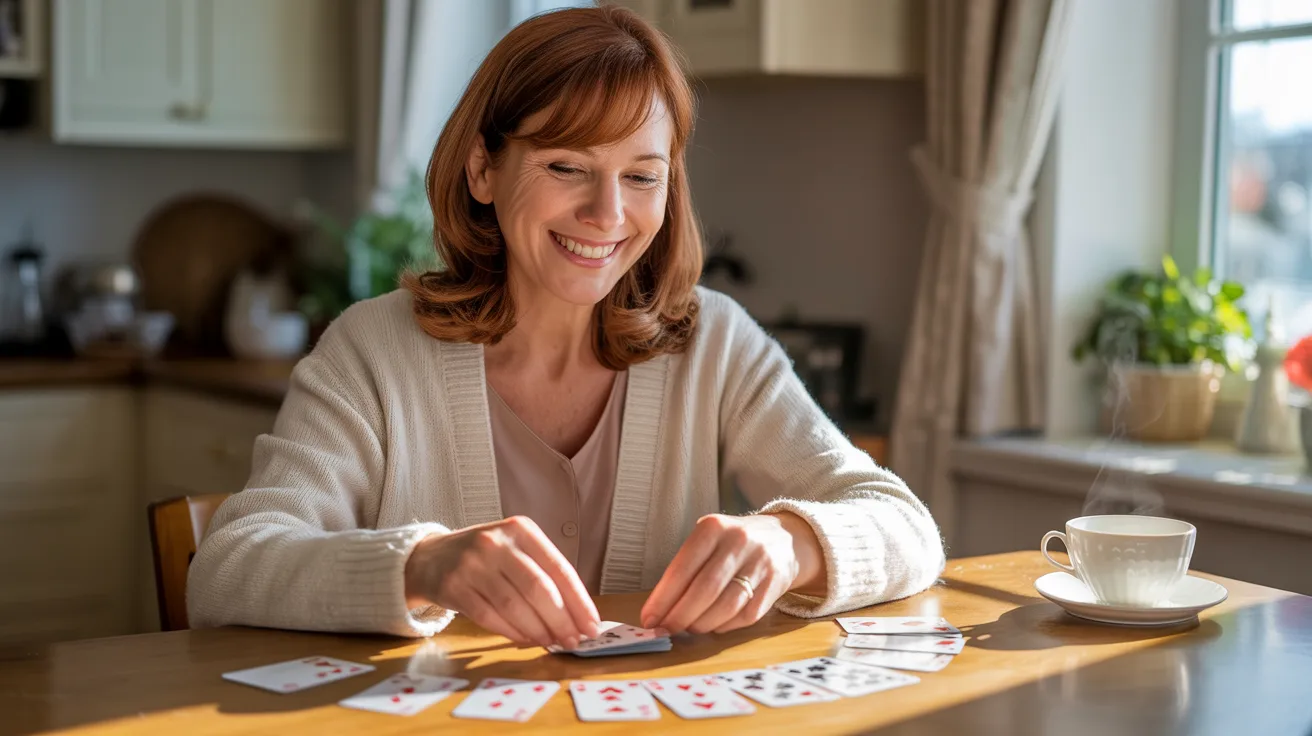
Think your solitaire habit is a guilty pleasure? Think again. Here's why being hooked on solitaire is actually good for your brain and wellbeing.
It starts innocently enough. You sit down for a quick five-minute game of Klondike, and the next time you look up, an hour has vanished. Sound familiar? If you've ever caught yourself thinking, "Why am I so addicted to solitaire?" - you're not alone, and more importantly, you shouldn't feel bad about it. As someone who has played thousands of games across dozens of variants, I can tell you with confidence: your solitaire habit might be one of the healthiest things you do all day.
The Psychology Behind the Solitaire Pull
Solitaire isn't just a card game - it's a finely tuned psychological loop. Every time you flip a card or uncover a hidden column, your brain releases a small hit of dopamine. This is the same reward mechanism behind puzzles, video games, and even social media scrolling. The crucial difference? Solitaire delivers that reward through genuine cognitive effort, not passive consumption.
Researchers at the University of Edinburgh have found that puzzle-based games engage the prefrontal cortex - the part of the brain responsible for planning, decision-making, and impulse control. When you're sitting there debating whether to move the red seven onto the black eight or hold off in case a better play emerges, you're not wasting time. You're training your brain.
That "just one more game" feeling? That's not weakness. That's curiosity, pattern recognition, and the very human drive to solve problems pulling you forward.
Solitaire Sharpens Real Strategic Thinking
One of the most common misconceptions about solitaire is that it's purely a game of chance. In reality, classic Klondike solitaire - the version most of us grew up with - has a theoretical win rate of around 79% when played with perfect strategy. The average casual player, however, wins only 33–43% of games. That gap is entirely skill.
The Decisions That Actually Matter
- Foundation timing: Experienced players know not to move cards to the foundation too early, as it can block critical tableau moves later.
- Empty column management: Creating an empty column is valuable real estate - don't fill it with the first card you can. Reserve it for a King that unlocks a long sequence.
- Stock cycling awareness: In draw-3 Klondike, tracking which cards are cycling through the stock is a genuine memory and probability skill.
- Sequence prioritization: Always ask yourself which move opens up the most face-down cards - that's almost always the right play.
These aren't trivial choices. They're the kind of layered, consequential decisions that translate directly into stronger analytical thinking in everyday life. The more you play, the more naturally this structured thinking comes - not just at the card table, but at the office, in the kitchen, everywhere.
It's a Genuine Mental Health Benefit
I've played solitaire through stressful deadlines, sleepless nights, and anxious afternoons. And I'm not alone. A 2021 survey by the American Psychological Association found that repetitive, low-stakes games are among the most effective casual interventions for anxiety and stress reduction. Solitaire fits this profile perfectly.
Why Solitaire Works as a Wind-Down Tool
The game demands just enough attention to quiet a racing mind without being so intense that it creates new stress. This is called the "flow state threshold" - a concept popularized by psychologist Mihaly Csikszentmihalyi. Solitaire sits in that sweet spot where the challenge matches your skill level, pulling you into a calm, focused present moment.
Unlike doomscrolling or watching TV, solitaire gives your mind a structured task. You're not passively absorbing - you're actively doing. That distinction matters enormously for how rested and reset you feel afterward. Many players, myself included, use a ten-minute solitaire session as a deliberate transition ritual between work and personal time. It genuinely works.
Solitaire Builds Patience and Resilience
Here's something no one talks about enough: solitaire teaches you how to lose well. Even with perfect play, some Klondike deals are mathematically unwinnable - roughly 20% of them, in fact. Learning to recognize an unwinnable position, accept it gracefully, and start fresh without frustration is a genuinely valuable life skill.
In Spider Solitaire, this resilience becomes even more pronounced. Four-suit Spider - the hardest mainstream variant - has a win rate of under 50% even for experienced players. Every session is a lesson in persistence, adaptability, and letting go of sunk-cost thinking. When you commit to a sequence in Spider and it unravels six moves later, you don't rage-quit (well, not after a while). You regroup, reassess, and try a different line.
That's not just good card play. That's good character development.
The Social and Creative Dimensions You Might Be Missing
Modern solitaire has quietly evolved into a rich, diverse hobby. Beyond Klondike, there's a whole world of variants - FreeCell, Pyramid, Golf, Canfield, TriPeaks - each with its own strategic personality. FreeCell, famously, has a win rate above 99% when played optimally, making it a satisfying game of pure skill. Pyramid challenges probabilistic thinking in a completely different way.
Online leaderboards, daily challenges, and streak-based scoring have added a light competitive layer that keeps the game fresh for long-term players. Discussing strategy in solitaire communities, comparing approaches to difficult deals, or simply sharing a screenshot of a satisfying win - these are genuine social experiences built around a shared passion.
If you've only ever played one variant, you haven't yet discovered the full depth of what solitaire offers. Trying a new variant every month is one of the best ways to keep your skills sharp and your enthusiasm alive.
So, Should You Feel Guilty About Your Solitaire Habit?
Absolutely not. A solitaire habit, played mindfully, is a form of active mental exercise, a stress-management tool, and a genuine skill-building pursuit rolled into one. The key word is mindfully - be aware of how long you're playing and make sure it's adding to your day rather than replacing things that matter. But a few games a day? That's not a guilty pleasure. That's a smart habit.
Next time someone raises an eyebrow at your solitaire obsession, you can tell them exactly what you're doing: you're training your brain, managing your stress, and getting better at something you love. That sounds like time very well spent.
Ready to play smarter? Explore our strategy guides for Klondike, FreeCell, and Spider Solitaire, and start turning your addiction into a genuine skill. Your next game is waiting.