Double Solitaire Turn 3
Added 02/2026
Double Solitaire Turn 3: The Ultimate Strategic Duel
By Martin Petroff
If standard "Draw 1" Double Solitaire is a frantic, high-speed race to empty your hand, Double Solitaire Turn 3 (or Draw 3) is a tense, calculated cold war. By introducing the strict three-card draw mechanic to the head-to-head format, the game slows down significantly, but the strategic depth goes through the roof. It is no longer just about who can move cards the fastest; it is about memory, precise timing, and manipulating the board state. Because you can only access the top card of a three-card cluster, you are heavily reliant on your opponent to make plays into the center foundation piles so you can finally unlock your own buried cards.
How to Play
The setup remains identical to standard Double Solitaire, requiring two players, a large table, and two standard 52-card decks with different patterned backs. The massive difference here lies entirely in how you handle your stockpile during your turn.
The Objective: Your goal is to get rid of as many of your cards as possible by playing them into the shared center Foundation piles. When the game inevitably stalls out, the player who has played the most cards into the center is declared the winner.
The Setup (The Dual Tableaus):
Both players shuffle their own 52-card decks.
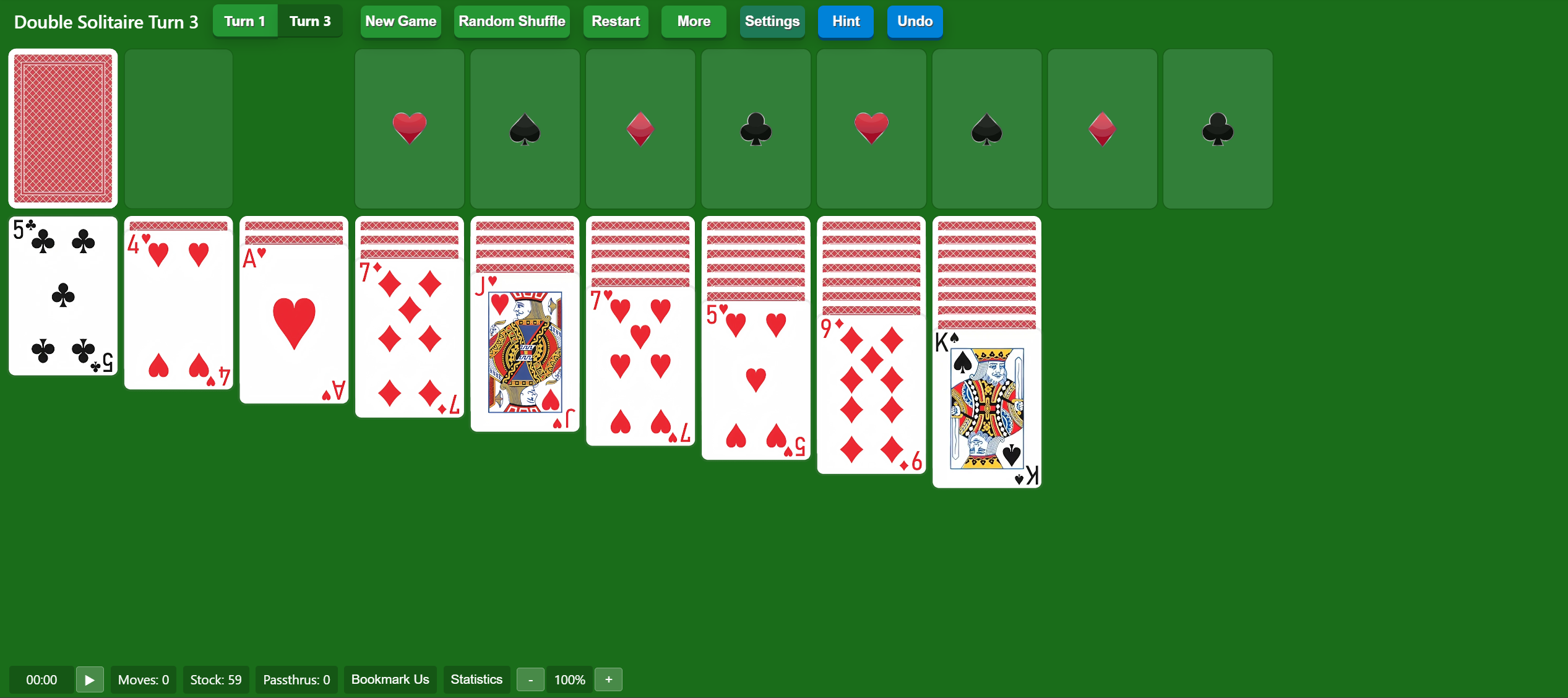
Both players set up a standard Klondike Tableau in front of them: seven columns, starting with one card on the left and ending with seven on the right.
The remaining cards form your personal, face-down Stockpile.
Leave a wide space in the middle of the table for the eight shared Foundation piles.
How to Play:
Taking Turns: The game is strictly turn-based. Player One takes their turn, making as many valid moves on their own Tableau and the shared center as possible.
The Turn 3 Draw: When you need new cards, you do not flip them one by one. You must draw three cards at a time from your Stockpile, placing them face-up in a Waste pile.
The Top Card Rule: You can only play the top, fully exposed card of the three you just drew. The two cards beneath it are locked. If you manage to play the top card, the one immediately beneath it becomes unlocked and available.
Ending Your Turn: Your turn immediately ends when you draw three cards, review the top card, and realize you cannot play it anywhere on your Tableau or in the shared center. It is then Player Two's turn.
Cycling the Deck: When your Stockpile runs out, you flip your Waste pile over (without shuffling!) to form a new Stockpile. Because you draw in sets of three, your deck's order remains static. If neither you nor your opponent makes a play, your next cycle will yield the exact same three-card clusters.
The Cold War Strategy: This is where the game shines. Sometimes, you might have a playable card, but you intentionally hold it back to block your opponent from playing a card they desperately need to get out of their Turn 3 cluster. You must carefully watch what your opponent is drawing and weaponize the shared center!
Winning: The game ends when one player empties their deck into the center, or when both players cycle through their Turn 3 stockpiles without making a single move, resulting in a mutual deadlock. Count the cards in the center to determine the victor!